


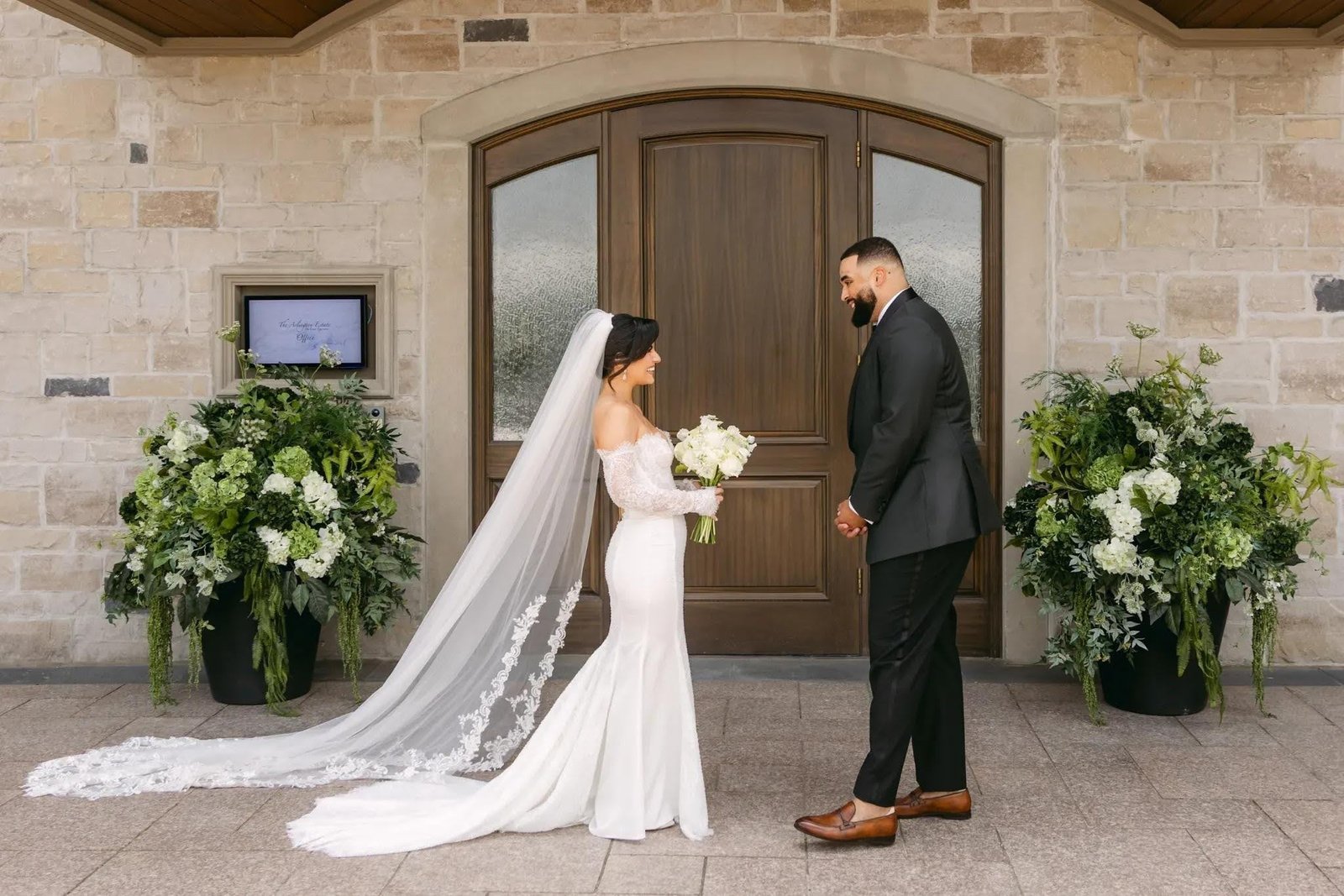
You can add off-the-shoulder straps or sleeves to many strapless wedding dresses, but the most successful conversions are designed around the gown rather than simply attached to it.
That distinction matters.
When a bride shows us an inspiration photo, we are looking at much more than the shape of the strap. We are looking at where it meets the bodice, how low it sits on the arm, what is supporting the gown underneath it, how the fabric behaves and what happens when the bride actually moves.
A beautifully designed off-the-shoulder addition can make a strapless dress feel softer, more romantic and entirely more personal.
Done poorly, it can pull the neckline out of shape, restrict the arms unnecessarily or look like an accessory that was added after the fact.
Our goal is always the first.
Why Brides Convert Strapless Gowns to Off-the-Shoulder
Sometimes a bride loves almost everything about her dress.
The waist is right.
The skirt is right.
The fabric is beautiful.
But after seeing the dress through several appointments, or perhaps after living with it for a few months, she begins imagining something across the shoulders.
That is not unusual.
An off-the-shoulder detail changes the frame around the upper body without requiring an entirely different gown. Depending on the design, it can soften a clean neckline, add texture, introduce lace or create a stronger sense of romance.
For some brides, that small change is what makes the dress finally feel like theirs.
A More Romantic, Versatile Look
A strapless neckline tends to feel clean and open.
Adding a soft off-the-shoulder drape can change that character immediately.
A folded satin band can make the neckline feel sculptural and polished. Soft tulle can make the same dress feel more ethereal. Lace applique can connect a simple bodice to other lace elements already present on the gown.
The important part is proportion.
An off-the-shoulder strap that is too wide can overwhelm a petite bodice. One that is too narrow may disappear visually or feel disconnected from a substantial skirt.
Where the strap begins and ends is just as important.
Even moving the attachment point slightly inward or outward can change the apparent width of the neckline and shoulders.
This is why we prefer to establish the placement while the bride is actually wearing the gown.
A Second Bridal Look, With Movement Considered
Detachable straps can give a bride more than one way to wear her dress.
She may prefer the off-the-shoulder look for the ceremony and portraits, then remove the straps later for a cleaner strapless reception look.
There is an important technical reality here: a fitted off-the-shoulder design does not automatically give you more arm movement.
In fact, because the strap sits below the natural shoulder, some restriction when raising the arms can be inherent to the silhouette.
During a fitting, we are balancing three things: the position of the strap, the amount of ease through the upper arm and the range of movement the bride needs.
If we add too much ease, the strap may sit lower than intended or lose its shape. If we make it too tight, movement becomes unnecessarily restricted.
A well-fitted off-the-shoulder strap finds the right balance rather than promising unlimited movement from a silhouette that naturally has some limitations.
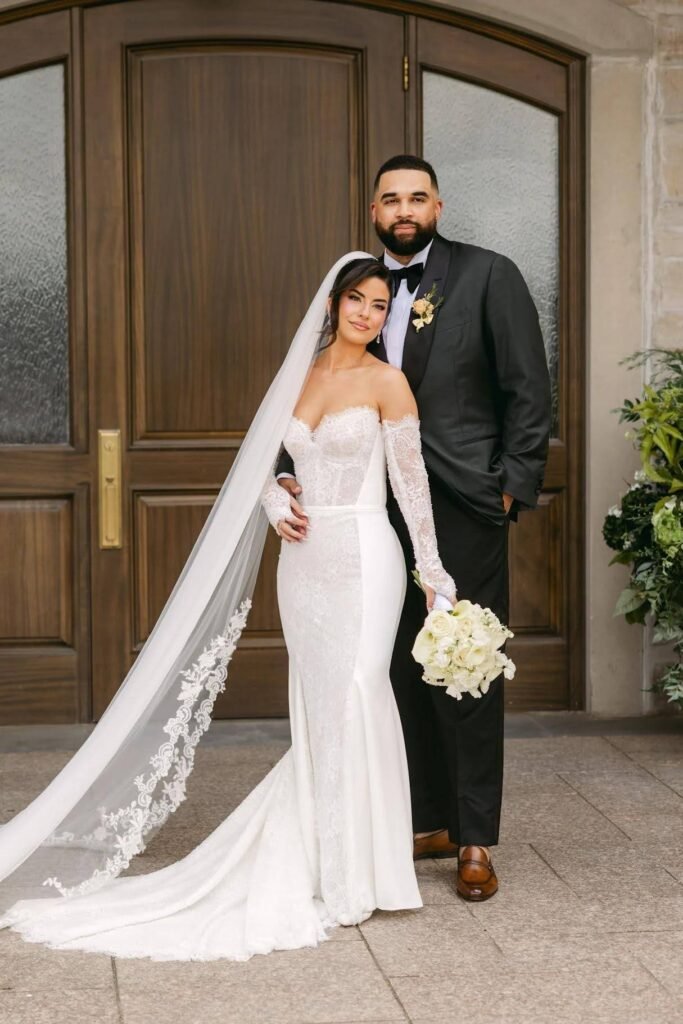
Detachable vs. Permanent Straps
One of the first design decisions is whether the off-the-shoulder straps should become a permanent part of the gown or remain removable.
Neither construction is automatically better.
It depends on how the bride wants to wear the dress and what the gown allows us to do.
When Permanent Straps Make Sense
Permanent straps can be a beautiful choice when the bride knows she wants the off-the-shoulder silhouette for the entire wedding day.
Because the strap does not need to be removed, we may have more freedom in how it is incorporated into the bodice.
Depending on the construction, it may be possible to integrate the strap more directly into the neckline, lining, seam structure or existing embellishment.
Permanent construction can also make sense when the design is complex.
For example, a lace applique that needs to appear as though it grows continuously out of the bodice may benefit from a more integrated construction than a completely removable element.
But permanent does not mean we simply stitch the strap onto the top edge.
We still need to consider what the fabric is anchored to, how much tension it creates and whether the new element changes the shape of the original neckline.
When Detachable Straps Make Sense
Detachable straps are ideal for a bride who genuinely loves both versions of her dress.
With straps, she gets the romantic off-the-shoulder silhouette.
Without them, she has the original strapless gown.
Depending on the dress and strap design, discreet hooks and loops, snaps, buttons or another concealed attachment system may be used.
The closure itself is only part of the construction.
We also have to consider what the closure is attached to.
Where the gown permits, an attachment that will experience tension should be secured into an appropriate seam allowance, underlining or foundation layer, reinforced lining area, or another structurally suitable part of the bodice rather than relying only on delicate lace, tulle or the outer fashion fabric.
Every dress gives us a different set of options.
Some designs are also held partly in position by their shaping, elastic or fit around the upper arm rather than relying entirely on bodice attachments.
Pairing Off-the-Shoulder Straps With Removable Sleeves
This is where bridal customization becomes especially interesting.
An off-the-shoulder element does not have to be limited to a simple band of fabric.
In some designs, the off-the-shoulder band and sleeve are separate components. In others, they are drafted as one continuous piece. We decide that construction based on the desired silhouette, fabric, weight, movement and the attachment points available on the gown.
A draped off-the-shoulder strap generally travels from the bodice across the upper arm. A fuller sleeve introduces additional patterning around the arm and may extend to the elbow, wrist or beyond.
Once we add that volume, we also add different considerations for weight, mobility and attachment.
If a bride wants a convertible bridal design with multiple removable elements, the entire gown should be planned as one cohesive system rather than adding each piece separately. This approach helps create a seamless look that works beautifully with the original dress structure.
Too many individual attachment points can become bulky or visually distracting. The cleaner solution is often the one that creates the fewest visible interruptions to the original gown.
Is Your Gown a Good Candidate?
Many strapless wedding dresses can be converted.
But “many” is not the same thing as “all.”
Before agreeing to the design, we need to see the actual gown.
Bodice Support and Off-the-Shoulder Placement
A properly fitted strapless gown should already support itself through its bodice.
Depending on the dress, that structure may include boning, a waist stay, an internal corselet, corsetry or other foundation layers.
An off-the-shoulder strap should generally not be used as a solution for a gown that is falling down.
This is particularly important because a true off-the-shoulder strap sits below the natural shoulder point. Unlike a conventional shoulder strap, it is not positioned to act as the primary vertical support for the gown.
If the strapless bodice is gaping, rotating or slipping, that fit issue needs to be corrected separately.
Once the bodice fits correctly, we can design the off-the-shoulder element around it.
Neckline and Strap Placement
Neckline shape has a major influence on where an added strap will look natural.
A sweetheart bodice, straight neckline and softly curved neckline can all support different strap proportions.
We also consider:
- the height of the bodice at the side seam
- the shape of the back
- whether the neckline is heavily embellished
- whether the edge is sheer
- the position of princess seams or boning
- where the strap can be anchored discreetly
- the bride’s own shoulder and upper-arm proportions
An extremely low back or transparent bodice does not necessarily make the alteration impossible, but it may limit where we can hide or reinforce the attachment.
Sometimes the original inspiration needs to be adjusted slightly to respect the gown’s construction.
That is normal custom work.
Fabric Weight and Structure
The same off-the-shoulder shape will behave differently in different fabrics.
Mikado has body.
Soft satin drapes.
Crepe tends to fall differently again.
Bridal tulle can range from crisp and structured to extremely fine and soft. For a close-fitting sleeve, we may instead use a stretch illusion mesh or stretch tulle when the design requires recovery and movement.
We therefore do not choose a strap width or pattern based only on a photograph.
The fabric itself has a say in the final design.
With satin and other fabrics that have a noticeable surface sheen, grain and direction are particularly important. A piece cut in a different orientation may catch the light differently even if it came from exactly the same fabric.
When lace is involved, we also need to consider motif scale, pattern direction, applique placement and how the new lace relates to what already exists on the bodice.
The Fitting and Attachment Process
The fitting is where an inspiration image starts becoming a design specific to the bride.
Testing Strap Placement and Movement
We typically want the main bodice fit established before finalizing the straps.
If the neckline, bust or side seams are still being altered significantly, establishing a final attachment position too early can create unnecessary rework.
Once the bodice is sitting correctly, we can test placement directly on the bride.
We look at the strap from the front, side and back.
Then we look at it while she moves.
Can she reach forward comfortably?
Hold a bouquet?
Hug someone?
Sit without the strap riding up?
Raise her arms enough for the moments she expects on her wedding day?
We are not only fitting the garment for a photograph. We are fitting it for several hours of actual wear.
Concealing Attachment Points
On some gowns, detachable attachment points can be made extremely discreet.
On others, there may be a small closure visible if you know exactly where to look.
A lace neckline gives us different opportunities than a completely clean satin edge. An opaque lined bodice gives us more options than certain transparent corset constructions.
For brides choosing detachable straps, we always need to consider the gown in both states:
How does it look with the straps?
And equally important:
How does it look once they are removed?
Neither version should feel unfinished.
Styling an Off-the-Shoulder Neckline
One reason this customization can be so effective is that the neckline becomes part of the overall styling of the bride.
Off-the-shoulder straps naturally draw attention to the collarbone and decolletage.
With a very clean gown, a structured band can feel modern and architectural.
With lace, it may feel softer and more traditional.
With gathered tulle, the result can be light and romantic.
We also consider what is happening around the neckline elsewhere.
If the gown already has significant applique, beadwork or a statement bodice, an elaborate sleeve may compete with it.
Sometimes the most luxurious customization is surprisingly restrained.
A beautifully proportioned fold of fabric that looks as though it came with the gown can be far more sophisticated than adding another heavily embellished feature simply because there is room to do so.
Cost and Timeline
There is no standard price for a strapless-to-off-the-shoulder conversion because the labour varies considerably.
A simple draped strap is very different from:
- a structured satin band
- a heavily embellished design
- hand-applied lace
- a detachable sleeve system
- a gown requiring internal reinforcement
- a sheer bodice requiring extremely discreet construction
- a design that needs several fitting adjustments
The cost reflects the design, construction, materials, handwork and fitting time required.
The same applies to timeline.
It is always better to discuss customizations earlier in the alterations process rather than waiting until the final fitting.
Even a seemingly simple addition can require patterning, fabric preparation, hand finishing and more than one fitting to get the proportion correct.
Frequently Asked Questions
Can straps be added to any strapless dress?
Many strapless gowns can have straps or sleeves added, but not every gown is suitable for every design.
We need to evaluate the neckline, internal construction, back height, fabric and intended attachment points before confirming the alteration.
Should I choose detachable or permanent straps?
Choose permanent straps if you know you want the off-the-shoulder silhouette throughout the day and prefer the most integrated construction possible.
Choose detachable straps if you genuinely want to wear the dress both ways.
The gown’s construction may also influence which option we recommend.
Can off-the-shoulder straps be paired with detachable sleeves?
Potentially, yes.
In some designs, the off-the-shoulder band and sleeve are separate. In others, they are constructed as one continuous removable piece. We choose the cleaner construction based on the desired look and the gown itself.
Will adding straps change how the bodice fits?
It should not be used to compensate for an incorrectly fitted strapless bodice.
However, adding a new element can introduce tension to the neckline if it is not patterned and attached correctly. This is why the bodice fit and strap placement need to be considered together.
Will the strap attachment points be visible?
On many gowns, detachable closures can be made extremely discreet.
How invisible they can be depends on the fabric, neckline and internal construction of the dress.
How much does a strapless-to-off-the-shoulder conversion cost?
The cost depends on the complexity of the design, fabric, construction, embellishment, attachment system and fitting time.
The most accurate quote comes from assessing the gown together with the bride’s inspiration.
How far in advance should this alteration be booked?
Custom design work is best discussed early in the bridal alterations process.
That gives the seamstress time to evaluate the gown, establish the bodice fit, determine materials, construct the straps or sleeves and refine them over the appropriate fittings.
The Best Customizations Don’t Look Added On
There is a very simple test we use when looking at a finished customization.
Does the new element make you think about the alteration?
Or does it simply look like the dress?
The second is always the goal.
A strapless-to-off-the-shoulder conversion should respect the architecture of the original gown while bringing the bride’s own vision into it.
Because bridal alterations are not only about making a dress smaller, shorter or tighter.
Sometimes they are about taking a dress a bride already loves and finding the final detail that makes it unmistakably hers.
At Mrs P Stitches, we specialize in bridal alterations and customizations in Toronto, including neckline transformations, custom straps and detachable sleeve designs created around the construction and proportions of the individual gown.