


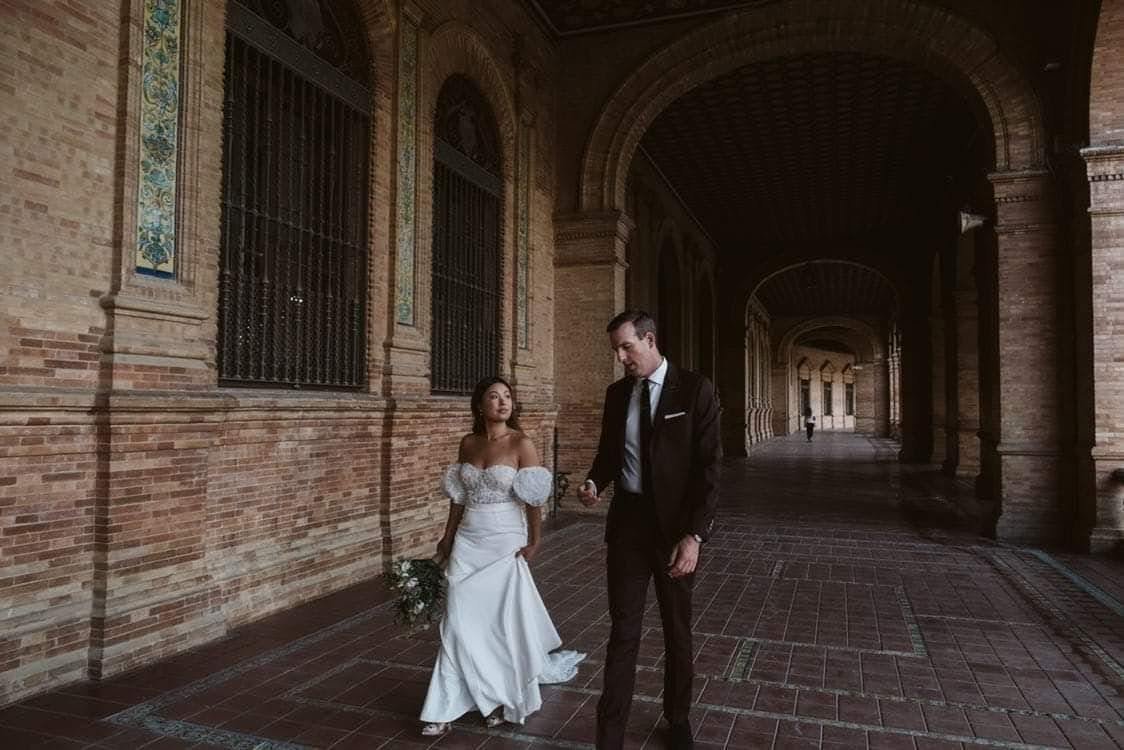
Detachable off-the-shoulder sleeves can be added to many strapless wedding dresses, but getting them right takes more than choosing a piece of fabric and attaching it to the neckline.
When we design sleeves for an existing gown, we first look at how the dress is constructed. We need to understand the bodice, where it gets its support, the neckline shape, the fabric, the available seam structure and how the bride needs to move in it.
Then we look at the design.
A good detachable sleeve should feel like it belongs to the gown. The proportion should make sense with the neckline, the fabric should sit naturally against the dress, and the attachment should be as discreet as the construction allows.
For brides who love their strapless gown but want a softer or more romantic look for part of the day, detachable sleeves can be a very practical customization. You can wear them for the ceremony and portraits, then remove them later and return to the original neckline.
What Are Detachable Off-the-Shoulder Sleeves?
In bridal, “detachable off-the-shoulder sleeves” can refer to several different constructions.
Some are draped bands that run from the front of the bodice, over the upper arm and back into the gown. Others are fuller sleeves positioned below the natural shoulder. Some are shaped closely around the upper arm, while others depend on attachment points at the front and back of the bodice.
They can be made in fabrics such as:
- tulle
- stretch tulle or illusion
- organza
- satin
- crepe
- Mikado
- lace
- appliquéd or embellished tulle
The construction changes depending on the fabric and the look we are trying to achieve.
A soft tulle drape behaves very differently from a structured Mikado band. A fitted illusion sleeve may depend on stretch, recovery and careful shaping. A lace sleeve may require motif placement, appliqué work or an illusion base. A satin sleeve requires particular attention to grain, sheen and drape because those differences can become obvious beside the original gown.
This is why custom sleeves are drafted, patterned and fitted to both the gown and the bride rather than treated as a generic accessory.
Tulle vs. Satin Off-the-Shoulder Sleeves
Tulle can create a very soft look without adding much visual weight, but not all tulle behaves the same way.
Some tulles are very fine and fluid. Others have more body. Stretch tulle and illusion mesh behave differently again and may be more suitable when a closer fit or greater flexibility is required.
The amount of stretch, recovery, stiffness and transparency all affect how the sleeve should be constructed.
An opaque woven fabric such as satin or Mikado gives us a more defined shape.
With satin especially, fabric direction matters. Changing the grain or orientation can change both the drape and the way the fabric reflects light. Even when we are using fabric from the original gown, the sleeve may look different if the pieces are cut without considering how the original skirt or bodice was laid out.
There is no single “best” fabric for detachable sleeves.
We choose the fabric and construction according to the gown, the desired silhouette and the amount of movement the bride needs.
Why Detachable Sleeves Work So Well for a Wedding Day
A lot of brides come to alterations with the same problem: they love their strapless dress, but they have also fallen in love with the look of sleeves. If you are considering a more permanent neckline change rather than a detachable option, you may also want to explore strapless to off-the-shoulder wedding dress alterations
That does not necessarily mean the gown needs to be permanently redesigned.
Detachable sleeves let us introduce another element without taking away the original neckline.
For the ceremony, an off-the-shoulder drape can soften a strapless bodice and change the way the gown photographs around the shoulders and décolletage.
Later, the sleeves can be removed and the bride has the clean strapless silhouette she originally purchased.
It is still the same dress, but the proportions can feel noticeably different.
How Do Detachable Sleeves Actually Attach to a Strapless Wedding Dress?
This is one of the areas that needs to be assessed gown by gown.
Depending on the design, we may use small snaps, hooks with thread loops or eyes, buttons, concealed loops or another custom closure.
Some sleeve designs may also be partially supported by their own shaping or fit around the upper arm rather than relying entirely on the gown.
The attachment method depends on:
- the weight of the sleeve
- where the sleeve needs to sit
- the construction of the bodice
- whether the gown has an appropriate place for an attachment
- whether the bodice is opaque, sheer or heavily embellished
- how much tension is created when the bride moves
- whether the closure needs to disappear when the sleeve is removed
A lightweight tulle drape does not create the same pull as an embellished lace sleeve or a structured satin sleeve.
The closure itself is only one part of the construction.
We also have to consider what that closure is anchored to.
Where the gown allows, an attachment carrying tension should be secured into an appropriate stable area of the bodice, such as a seam allowance, lining, foundation layer or reinforced section, rather than relying only on delicate lace, tulle or fashion fabric.
The exact method depends on how the individual gown has been constructed.
That detail matters because even a very small closure can experience repeated tension once the bride begins reaching, hugging, sitting and dancing.
Detachable Sleeves Should Not Be Holding Up Your Strapless Dress
This is an important distinction.
A properly fitted strapless gown should be supported through the fit and internal construction of the bodice.
Depending on the gown, this may include boning, a waist stay, an internal corselet, corsetry or other foundation layers.
Cups can help shape and support the bust, but they should not be relied on to hold the gown itself in position.
A draped off-the-shoulder sleeve is generally a design element. We do not want to depend on it to keep an otherwise loose strapless bodice in place.
If the gown is slipping, rotating, gaping or dropping before the sleeves are attached, we address the bodice fit separately.
Adding sleeves is not a substitute for fitting the foundation of the dress correctly.
Will the Attachment Points Show?
Sometimes they can be almost completely concealed.
Other times there may be a very small attachment point visible if you know where to look.
This depends heavily on the gown.
A lined satin bodice gives us very different options from an unlined illusion bodice. Heavy lace or appliqué can disguise construction that would be much more noticeable on a clean crepe or satin neckline.
If the bride intends to wear the dress both with and without sleeves, we assess both versions during the fitting.
The gown still needs to look finished once the sleeves are removed.
Can Detachable Sleeves Be Added to Any Strapless Wedding Dress?
Not automatically.
Many strapless dresses are good candidates, but the dress needs to be assessed before we confirm the design.
We look at:
- bodice construction
- neckline
- front and back height
- existing seams
- internal structure
- fabric strength
- embellishment
- transparency
- fit through the bust and waist
- the proposed sleeve style
Some gowns give us excellent places to integrate discreet attachments.
Others require more problem-solving.
A very sheer bodice, extremely low back, delicate lace edge or neckline with little internal structure may limit where attachments can be placed without changing the appearance of the gown.
That does not always mean sleeves are impossible.
It may mean the original inspiration needs to be adapted to the construction of the dress.
Movement Is Part of the Fitting
This is one of the areas where a sleeve can look beautiful standing still and fail in real life.
An off-the-shoulder sleeve sits across an area of the body that moves constantly.
If the sleeve is too short from front to back or fitted too tightly across the upper arm, the bride may feel pulling as soon as she reaches forward or raises her arms.
If it is too loose, the sleeve may drop lower than intended, twist or lose its shape.
During fittings, we need to see what happens when the bride actually moves.
Raise your arms.
Reach forward.
Hold your bouquet.
Give someone a hug.
Sit down.
With a true off-the-shoulder sleeve, some restriction in upward arm movement can be inherent to the design.
Adding more ease, changing the sleeve shape or adjusting the attachment geometry can improve mobility, but at a certain point it can also change where the sleeve sits and how the design looks.
The fitting is therefore a balance between the intended silhouette and the bride’s required range of motion.
Our job is not to promise unlimited movement in a design that naturally restricts it.
Our job is to make sure the sleeve is correctly fitted, not unnecessarily restrictive and appropriate for how the bride wants to wear the dress.
Matching the Sleeve to the Original Wedding Dress
Fabric matching is often one of the most difficult parts of adding something new to an existing gown.
“White” and “ivory” are very broad descriptions in bridal.
Two ivory satins can differ in undertone, weave, thickness, lustre and stiffness. Put them beside each other under natural light and the difference can become obvious.
This is one reason leftover fabric from the actual gown can be so valuable.
Can We Use Fabric Removed From the Hem?
Sometimes, yes.
If a gown needs to be shortened and the hemming method leaves us with usable excess fabric, that fabric can sometimes be repurposed into sleeves or another customization.
It is an excellent option because we are working with material from the actual gown rather than trying to approximate the colour and finish with a different fabric.
However, even fabric from the gown itself still needs to be handled carefully.
Directional sheen, grain, fabric orientation, seams and embellishment placement can affect how a new piece reads once it is constructed into a sleeve.
We also never assume there will be enough usable material.
We need to see:
- how much length is actually being removed
- the width and shape of the skirt panels
- whether seams run through the usable area
- the grain and direction of the fabric
- whether there is a directional sheen
- whether the hem contains lace, appliqué or beading
- whether horsehair braid or another hem treatment affects the usable area
- how much fabric the sleeve pattern requires
Certain dresses are also not shortened in a way that produces a large, clean section of excess fabric.
For example, lace borders may need to be removed and repositioned, and some gown constructions leave very little usable material after the hem is completed.
So while hem fabric is always worth investigating, it is never something we promise before seeing the gown.
Does Using Hem Fabric Change the Final Dress Length?
Not when we are using fabric that would already be removed while hemming the gown to the correct finished length.
The correct hem is determined first.
Only material beyond that finished length is considered available for another purpose.
We would not shorten a bride’s gown beyond its correct length simply to produce additional fabric for sleeves.
What If There Isn’t Enough Fabric?
Then we look at what other materials are available.
Mrs. P Stitches does not source fabric on behalf of clients. If additional material is required, we can advise the bride on what type of fabric or trim may be appropriate, but the client is responsible for bringing the required materials.
Sometimes trying to find an almost-identical opaque fabric is not the best design solution.
If a true match is not available, an intentional material change, such as illusion tulle, lace or another complementary fabric, can look much more refined than an opaque fabric that is close but visibly different from the original gown.
Matching Lace Requires More Than Matching Colour
When the gown is lace, matching a sleeve may involve much more than finding a lace with a similar colour.
We look at:
- the scale of the motifs
- the direction of the design
- the density of the lace
- the spacing of the repeat
- whether the gown uses corded, embroidered or appliquéd lace
- whether the motifs can be isolated individually
- how heavily the original gown has been embellished
There are also different ways to construct a lace sleeve.
One option is to cut the sleeve directly from lace yardage.
Another is to build the sleeve on an illusion or tulle base and place individual lace motifs over it.
The second method can give us much more control over placement and can be especially useful when we want the appliqué to visually continue from the bodice into the sleeve.
The goal is not simply to add lace.
The goal is to make the new lace placement feel connected to the visual language of the original gown.
Designing the Sleeve Around the Gown
When we begin a sleeve customization, inspiration photos are useful, but we do not copy them blindly.Every gown presents different construction challenges, which is why the customization process begins with a careful assessment of the dress and the bride’s desired result. You can also learn more about the Mrs. P Stitches bridal atelier experience in Toronto
We look at what the bride actually responds to in the reference.
Is it the way the fabric drapes?
The amount of arm coverage?
The width of the sleeve?
The volume?
The position below the shoulder?
The way the sleeve connects to the bodice?
Once we understand that, we can translate the idea to the bride’s actual dress.
Two gowns can have the same general sweetheart neckline and still require completely different sleeve patterns because the bodice height, side seam position, back shape, bride’s proportions and fabric behaviour are different.
The final sleeve is designed for the person wearing it and the gown it is being attached to.
The Custom Sleeve Process
1. Assess the gown
Before deciding how the sleeve will be made, we inspect the gown’s construction and fit.
If the strapless bodice still requires substantial alterations through the bust, waist, neckline or back, those adjustments need to be considered before the final sleeve placement is established.
2. Review the inspiration
We use reference photos to understand the desired shape and feeling rather than treating them as an exact pattern.
3. Confirm the available material
If fabric will come from the gown, we determine what will actually be available after the necessary alterations have been completed.
If another fabric, lace or trim is required, the bride brings the appropriate material to the studio.
4. Establish the proportion
We test where the sleeve should sit and how much width, volume or drape works with the neckline and the bride’s proportions.
5. Draft and construct the sleeves
The sleeve is patterned and constructed according to the chosen design and fabric.
For lace or embellished designs, this stage may include careful motif placement, hand appliqué, beading or other hand finishing.
6. Fit for appearance and movement
The bride tries the sleeves on with the gown so we can assess position, comfort, range of motion and tension.
A sleeve is not finished just because it looks good while the bride is standing still.
7. Finalize the detachable attachment
Once the final placement is confirmed, the closures and any necessary reinforcement are completed and tested.
We also make sure the bride understands exactly how to attach and remove the sleeves safely.
Will Detachable Sleeves Damage the Dress?
“Detachable” does not necessarily mean that nothing is sewn onto the gown.
If closures need to be added to the bodice, those attachment points become part of the alteration.
The goal is to keep them discreet and place them in a way that is appropriate for the construction of the dress.
A professionally installed attachment should not be yanked or pulled apart.
On the wedding day, whoever is helping the bride remove the sleeves should know where each closure is and how it releases.
That is particularly important with delicate tulle, illusion, lace and beaded fabrics.
We recommend practising this during the final fitting rather than trying to figure it out during the reception.
Caring for Detachable Wedding Sleeves
Store the sleeves with the same care as the gown.
Depending on the construction, this may mean keeping them flat, lightly supported or separately protected so that the fabric, appliqué or sleeve shape is not crushed.
Be especially careful with:
- fine tulle
- stretch illusion
- lace
- appliqué
- beads
- sequins
- delicate thread loops
- structured sleeves that can lose their shape when folded
Do not automatically iron or aggressively steam a bridal sleeve.
Different fabrics, synthetic fibres, embellishments, adhesives and finishes react differently to heat.
Follow the care instructions given for your particular gown and sleeve construction.
How Much Do Custom Detachable Sleeves Cost?
There is no meaningful one-price answer because “detachable sleeve” covers a very wide range of work.
A simple draped tulle band and a fully patterned sleeve with hand-applied lace, beading or structured satin construction are completely different projects.
Pricing depends on factors such as:
- pattern-making
- fabric
- number of layers
- construction complexity
- lace placement
- embellishment
- handwork
- attachment method
- reinforcement required inside the bodice
- changes required to the gown
- number of fittings
The most accurate way to price the work is to assess the actual dress and the proposed design together.
Frequently Asked Questions
Can detachable sleeves be added to a strapless wedding dress?
Often, yes.
We first need to assess the gown’s neckline, internal construction, fabric, fit and the type of sleeve being considered. Some dresses are much more straightforward to customize than others.
Do detachable sleeves help hold up a strapless dress?
They should not be relied on as the primary support for the gown.
A strapless dress should fit and support itself correctly through the construction of the bodice. Detachable sleeves are generally a separate design element.
How are detachable wedding sleeves attached?
Possible methods include small snaps, hooks and thread loops or eyes, buttons, concealed loops and other custom closures.
Some sleeve styles may also be partially self-supporting around the upper arm.
The correct method depends on the gown, the sleeve design and what stable areas are available inside the bodice for reinforcement.
Can sleeves be made from fabric removed when my dress is hemmed?
Sometimes.
If the hem alteration produces enough usable fabric, it can be an excellent option because the material is from the original gown.
We still need to consider grain, direction, sheen, seams, embellishment and how much fabric the sleeve pattern requires.
Will the attachment show once I remove the sleeves?
That depends on the gown and attachment method.
On many dresses, the closures can be made very discreet.
Sheer, low-backed and very minimal gowns can be less forgiving, so this needs to be assessed during the fitting.
Can I move normally in off-the-shoulder sleeves?
You should be able to move comfortably within the limitations of the design.
A true fitted off-the-shoulder sleeve will naturally restrict some upward arm movement compared with a strapless dress.
During fittings, we balance the intended sleeve position with the amount of movement the bride needs.
Can I wear the sleeves for the ceremony and remove them for the reception?
Yes.
That is one of the main advantages of making the sleeve detachable.
Do I need to bring my own fabric?
If additional fabric, lace, appliqué or other materials are required for the customization, yes.
Mrs. P Stitches does not source fabric on behalf of clients. We can advise on the type of material required, and if suitable excess fabric becomes available from your gown alterations, we can assess whether it can be repurposed.
Thinking About Adding Sleeves to Your Wedding Dress?
If you love your dress but keep coming back to the idea of sleeves, bring the gown and your inspiration with you.
How should this sleeve be constructed so that it actually belongs on this dress?
That is the difference between attaching something to a wedding gown and properly customizing it.
At Mrs. P Stitches, we specialize in bridal alterations and customizations in Toronto, including detachable and convertible sleeve designs created around the construction, fabric and proportions of the individual gown.