

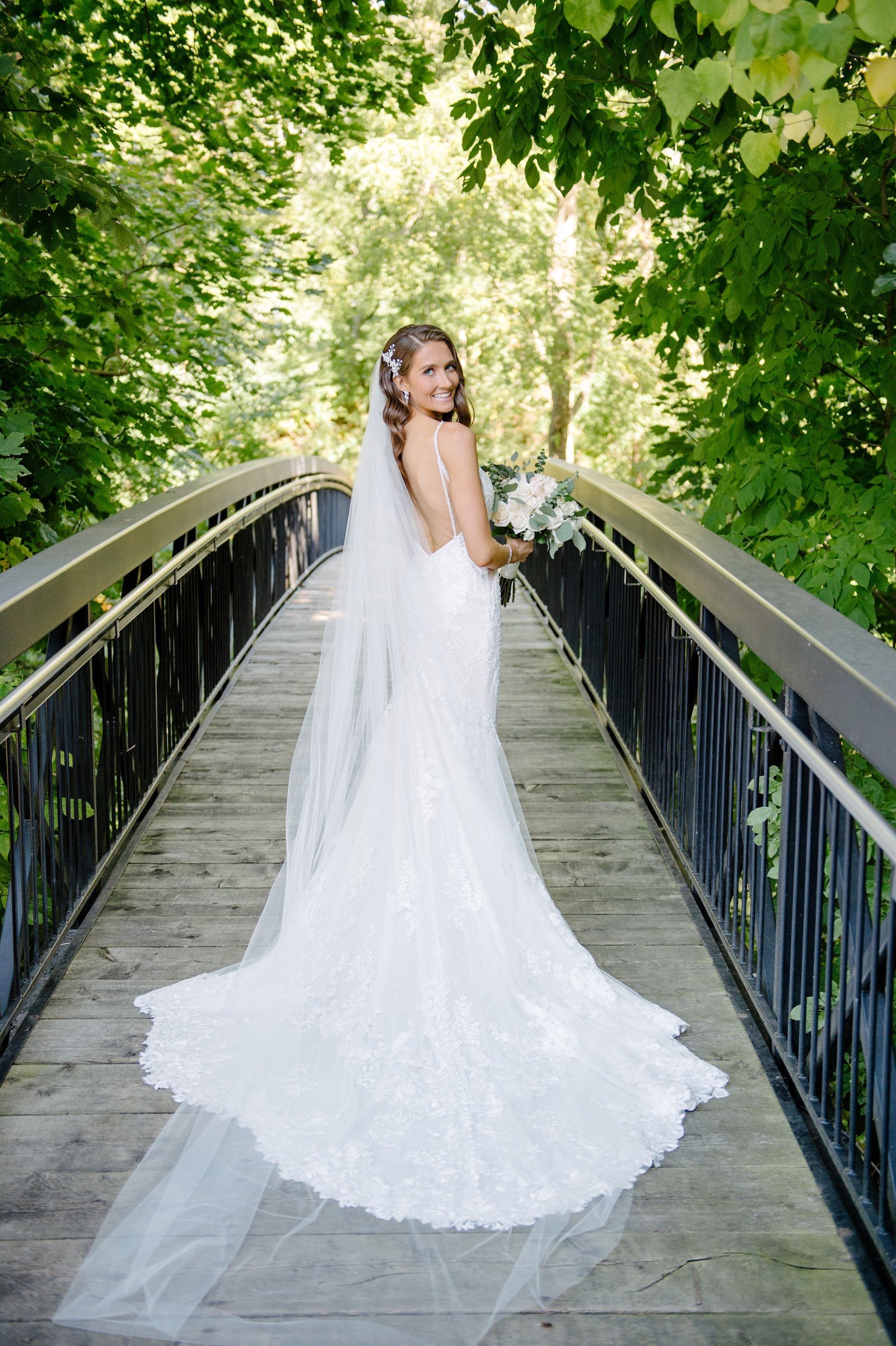
Your train is breathtaking walking down the aisle. Ten minutes into the reception, it becomes something everyone steps on.
A bustle solves that. It lifts and secures your train so you can dance, hug and move freely, and it should look as intentional as the gown itself. Done well, guests won’t know where the ceremony look ends and the reception look begins.
Here are the three main styles, and how we choose between them.
American bustle (over-bustle)
The train is lifted up and over, then fastened to the back of the skirt with hooks, buttons or loops. It creates soft drapes that fall from the waist or hip.
Best for: lighter fabrics such as chiffon, tulle and organza, and trains with lace or beading you want to show off.
Good to know: it is usually the quickest to fasten on the day.
French bustle (under-bustle)
The train is tucked under the skirt and tied with ribbons on the inside. It creates gathered folds and volume at the back, almost like a second skirt.
Best for: satin, mikado, crepe and other heavier fabrics, and ball gowns.
Good to know: the ribbons are numbered or colour-coded, so your helper ties them in order.
Ballroom bustle
The train is folded under and secured so the skirt hangs at one even length all the way around. It looks as if the gown never had a train.
Best for: brides who want a clean, floor-length look for dancing.
Good to know: it takes the most points and the most precision. Each point has to land exactly to keep the hem level. It can also leave a visible dust mark mid-train.
How we choose the right bustle for your gown
There is no single best bustle. The right one depends on:
- Fabric weight. Heavy satin or mikado drags on hooks and can pull the skirt out of shape; it usually sits better tied under than lifted over.
- Train length. Longer trains need more points to spread the weight evenly.
- Lace and beading. Hooks and loops are hidden inside the lace motifs so the bustle disappears.
- Your reception. A full night of dancing needs a stronger, more secure bustle.
- The look you want. Some brides want drama; others want the gown to look floor length.
We pin your bustle on you at a fitting so you can see it in the mirror, walk in it and dance in it, before a single stitch is made.
How many bustle points will you need?
It depends on the train. A short sweep train may need one to three. A cathedral train can need many more. More points spread the weight, keep the fabric from sagging, and make the bustle last through the night.
On the day
At your final fitting, bring the person who will bustle your dress: your maid of honour, your mother or a close friend. We will teach them, step by step, until they can do it with confidence.
Bustles are part of our bridal alterations service, fitted on your gown, to your train and your night.